AI SEO for WordPress: How to Get Cited by ChatGPT, Perplexity and Google AI Overviews
AI SEO, also called generative engine optimization or answer engine optimization, is the work of getting your pages quoted inside AI answers. Most of it is good SEO done properly. This guide shows how the engines choose sources, which popular tactics are myths, and how to fix a WordPress site step by step.
What is AI SEO? Generative engine optimization and AEO explained
AI SEO is the practice of making your pages easy for AI search tools to find, trust and quote. The goal is to be cited as a source inside answers from Google AI Overviews, Google AI Mode, ChatGPT search, Perplexity, Gemini and Claude. It builds on normal SEO: a page that is not crawled and indexed cannot be cited.
SEO for AI search goes by several names. The industry has not settled on one, so here is how they map:
| Term | What people usually mean |
|---|---|
| AI SEO | The umbrella term. Optimising a site for AI powered search as well as classic results. |
| GEO (generative engine optimization) | Getting cited in answers written by generative AI, such as ChatGPT and Perplexity. |
| AEO (answer engine optimization) | Structuring content so a system can lift a direct answer. Older term, first used for featured snippets and voice search. |
| AI search optimization | Same as GEO, used more by marketers than SEOs. |
| LLM SEO or ChatGPT SEO | GEO aimed at one platform, usually ChatGPT. |
Five names, one job: be the page an AI answer quotes.
Google’s own position is blunt. In its guide to generative AI features, updated 10 July 2026, it says the work people call AEO and GEO is still SEO, and that there are no additional requirements to appear in AI Overviews or AI Mode. That is good news. You do not need a second strategy, you need the first one done well.
How AI search engines choose which pages to cite
Every AI search product works in roughly the same way. Understanding the steps tells you where a page can drop out.
Google calls the second step query fan out, and it is why AI answers often cite pages that do not rank first for the exact question. A page that answers one sub question clearly can be pulled in even if it ranks on page two for the main query.
The third step is the one most guides skip. Each engine retrieves from an index, and they do not all use the same one:
| Engine | Where it finds pages | Crawler to allow | What that means for you |
|---|---|---|---|
| Google AI Overviews and AI Mode | Google’s normal search index | Googlebot | Rank and index in Google. Nothing extra is needed. |
| ChatGPT search | Its own crawler plus partner search data, largely Bing | OAI-SearchBot | Get indexed in Bing and do not block OAI-SearchBot. |
| Perplexity | Its own index | PerplexityBot | Do not block PerplexityBot; fresh, well sourced pages do well. |
| Claude | A web search partner plus its own crawler | Claude-SearchBot | Do not block it if you want Claude to cite you. |
| Gemini app | Google Search grounding | Googlebot | Same as Google Search. |
If you are not in the index an engine searches, you cannot be cited by it.
AI SEO myths Google has now ruled out
A lot of paid advice in this space is guesswork. Google published a mythbusting section in May 2026 and it removes several popular tactics in one go:
| Popular advice | What Google says | Verdict |
|---|---|---|
| Add llms.txt so AI can read your site | Google Search ignores llms.txt and other special AI files | Optional, not a Google factor |
| Chunk pages into small blocks for AI | Its systems understand long pages that cover several topics | Not needed |
| Rewrite content in an AI friendly style | Its systems handle synonyms and phrasing on their own | Not needed |
| Add special schema for AI answers | No special markup is required for AI features | Normal schema still helps rich results |
| Seed brand mentions across the web | Inauthentic mentions are not a strategy it rewards | Avoid |
Source: Google Search Central, Optimizing for generative AI features on Google Search.
Two notes on that table. First, Google is one engine. Some AI agents and developer tools do read llms.txt, so it is fine to keep one if a plugin maintains it. Second, schema markup is not an AI shortcut, but it still earns rich results and removes ambiguity about who you are, which is worth having anyway.
What actually earns AI citations: ChatGPT SEO and AI Overviews
Strip out the myths and the list is short. These are the signals that decide whether an engine picks your passage over someone else’s.
1. Say something the other results do not
Google’s guide puts this first: non commodity content. If your page repeats the same ten tips as every other page, an AI answer has no reason to cite you rather than any of them. Original numbers, real examples, your own test results, local detail and a clear opinion are what make a page worth quoting.
2. Answer first, then explain
Put a direct two or three sentence answer under each question heading, then the detail. That is how people skim, and it gives an engine a clean passage to lift. The quick answer boxes in this article follow the same pattern.
3. Make the structure obvious
Use real headings in order, short paragraphs, lists for steps and tables for comparisons. Tables are especially useful because they state facts side by side with no room for misreading.
4. Show your evidence
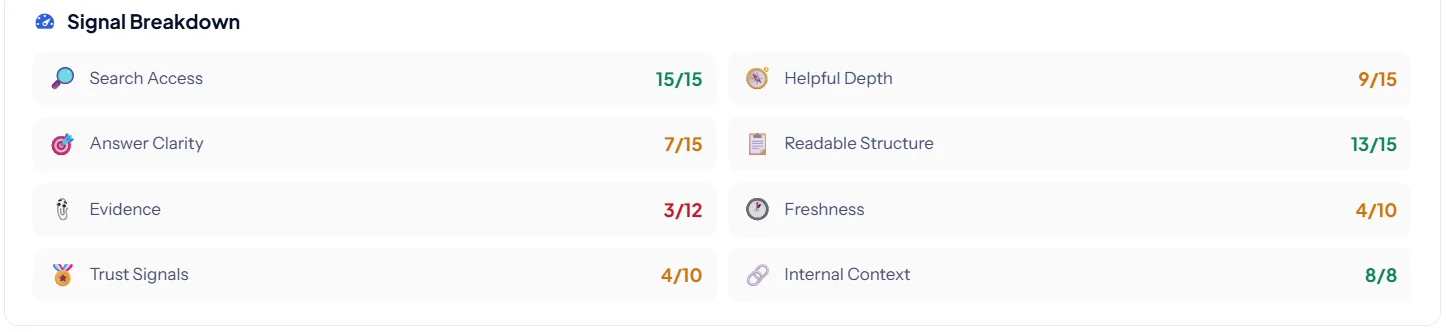
Name sources, link to official documentation and show dates. A claim with a source is safer for an engine to repeat than a claim without one. This is also the signal most sites score worst on, as the chart below shows.
5. Keep it fresh and say so
Perplexity in particular favours recent pages. Update pages when facts change, remove stale claims and show a visible updated date. Do not change the date without changing the content.
6. Be clear about who is talking
An author name, a short bio that explains why they know the topic, and consistent business details across your site help engines connect the page to a real person or company.
7. Cover the topic, then link it together
Fan out rewards sites that answer the follow up questions too. Build a pillar page with supporting articles and connect them with internal links so both crawlers and readers can move from the broad question to the specific one. The method is in the guide to topic clusters and pillar pages.
That chart is the signal breakdown for a 1,131 word guide on our demo site. Technically it is perfect: crawlable, indexable and well linked. It loses points on the things only a writer can fix: a clear answer up top, sources, dates and author trust. That pattern is typical.
The technical checks for AI search
Content decides whether you are chosen. These settings decide whether you are even eligible.
- Indexing. Check the page is indexed in Google Search Console and in Bing Webmaster Tools. No index, no citation.
- Snippets allowed. Google only uses pages eligible for a snippet. A
nosnippettag or a very lowmax-snippetvalue keeps you out of AI Overviews too. - AI search crawlers allowed. Check robots.txt does not block OAI-SearchBot, PerplexityBot or Claude-SearchBot. Some security plugins and CDNs block them by default.
- Content in the HTML. Text that only appears after JavaScript runs, inside tabs that load later, or in images is harder for AI crawlers to read.
- Fast, stable pages. Slow or error prone pages get crawled less often, which means stale copies in AI indexes.
Most businesses want to appear in AI answers without donating their content to model training. Search crawlers and training crawlers are separate, so you can split them in robots.txt:
# Stay visible in AI search and answer engines
User-agent: OAI-SearchBot
Allow: /

User-agent: PerplexityBot
Allow: /

User-agent: Claude-SearchBot
Allow: /

# Opt out of model training only
User-agent: GPTBot
Disallow: /

User-agent: Google-Extended
Disallow: /How to do AI SEO in WordPress
You can do everything above by hand: write the answers, edit robots.txt, check indexing in two consoles. The hard part is doing it on every post, every time. This is how I handle it in SEO Rank Genius.
Score each post for AI readiness
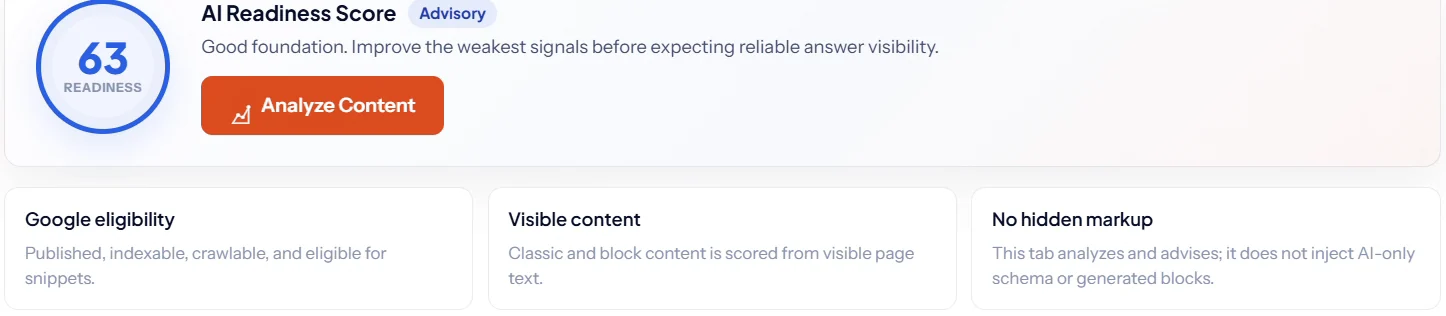
In the post editor, the AI Readiness tab scores the content out of 100. It reads the visible text only, and it does not inject hidden markup or AI only schema into your page. It checks Google eligibility first: published, indexable, crawlable and allowed in snippets.
Below the score, the signal breakdown shows exactly which of the eight signals from the chart above is dragging the post down, so you know whether to add sources, tighten the opening answer or refresh old sections.
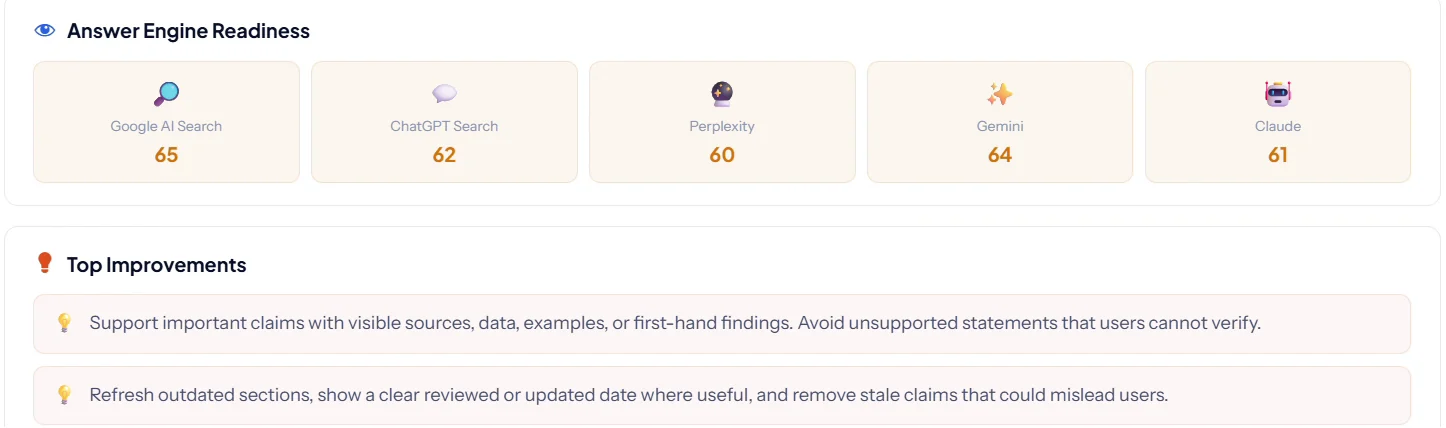
The panel then estimates readiness per engine for Google AI Search, ChatGPT search, Perplexity, Gemini and Claude, with the top improvements written in plain language. Treat these as estimates. No tool can see inside an engine’s ranking, and anyone who claims otherwise is guessing.
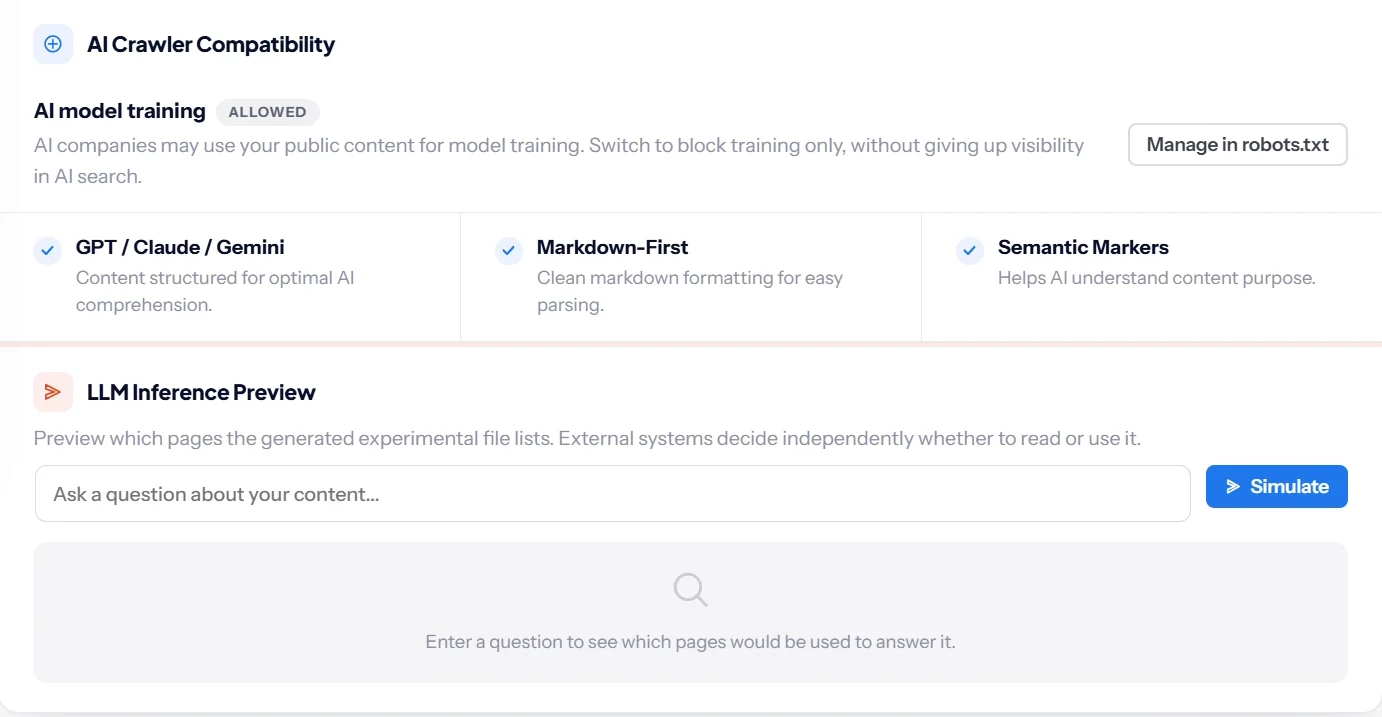
Control AI crawlers site wide
Under Indexing and Sitemaps, then AI and LLM Indexing, you decide whether AI companies may train on your content. Blocking training is managed through robots.txt and does not remove you from AI search. The same screen generates llms.txt and llms-full.txt, and an inference preview shows which of your pages the generated file would point an AI tool to for a given question.
For the other pieces, turn on IndexNow so Bing and other engines hear about updates straight away, keep a clean XML sitemap, and add schema for your business, articles and FAQs. All of it is included in the plugin; see the current plans.
How to measure AI search traffic
This used to be guesswork. It is now partly measurable.
- Google Search Console. The Search Generative AI performance report launched in June 2026 and reached every site worldwide on 31 August 2026. It shows impressions from AI Overviews, AI Mode and AI features in Discover by page, country, device and date. Data starts on 18 May 2026, and clicks are not included yet.
- Analytics referrals. In GA4, look at sessions from chatgpt.com, perplexity.ai, gemini.google.com and claude.ai. They are small for most sites but they convert well because the visitor arrives already informed.
- Bing Webmaster Tools. Worth checking because Bing data sits behind much of ChatGPT search.
- Manual checks. Once a month, ask the engines the ten questions your customers ask most and note who gets cited. Use a private window so your own history does not skew the result.
AI SEO checklist for WordPress
- Page indexed in Google and Bing, snippets allowed.
- robots.txt allows OAI-SearchBot, PerplexityBot and Claude-SearchBot; training bots blocked only if you want that.
- A direct answer under every question heading.
- At least one thing on the page that competitors do not have: data, a test, an example or a clear opinion.
- Sources linked, dates shown, author named with a real bio.
- Headings in order, lists for steps, tables for comparisons.
- Supporting articles linked to and from a pillar page.
- Organization, Article and FAQ schema where they genuinely fit.
- IndexNow on, sitemap clean, updates pushed the day they happen.
- AI impressions checked monthly in Search Console.
Where to start
If you do three things this week, make them these: verify your site in Bing, check robots.txt for blocked AI search crawlers, and rewrite the opening of your five most important pages as direct answers with a source. Then work through internal linking and schema markup, which help classic rankings and AI citations at the same time.
SEO Rank Genius scores every post for AI readiness, manages AI crawler access and keeps llms.txt and IndexNow running in the background.